| How it started
In January 2000, I was starting to consider getting a cat. I grew up with
a cat named Charlie from when I was 4 to when I was 21, and Charlie would
sleep with me every night, he would come whenever I called him, even when
he was asleep (he was as loyal as any dog in that way), and he would always
sleep on my lap when I did homework from school. I missed the companionship
of animals, I like the independence that cats demonstrate, and I liked the
fact that I could keep a litter box and not worry about having to take him
out 2-3 times a day to go to the bathroom like I would have to do with a dog.
But even with a litter box, I was considering all the drawbacks of having a
litter box, mentioned on my
introduction page, from sanitation to litter expenses to my own laziness
in not wanting to scoop poop and pee clumps every 1-2 days.
My fiancee suggested that I find out about the possibility of toilet
training my cat. I thought this was a crazy idea at first, but I searched
Yahoo for "toilet train cat"
and came up with "Karawynn's" page on training your cat.
The seemingly crazy idea actually
turned out to be a reality, because there were numerous other web
sites out there on toilet training your cat, as well as plenty of books
published on it. The seed was planted.
As a reward for finishing the first year of my masters degree in piano
performance, I finally decided to get a kitten, and I adopted a 2-1/2 month
old kitten from the Nevada Humane Society. I named him Allegro.
When I went to the pet store to get pet supplies for my new kitty, guess what
I found? You guessed it - a cat toilet training kit called Kitty Whiz. I
immediately bought it, but the vet told me that he was probably too young to
begin training,
since jumping up to the toilet seat would be intimidating for him at his young
age. I bought into that idea and went ahead with a temporary litter box until
I felt he was ready to begin training.
First failure
When Allegro was able to comfortably stand on his hind legs to look inside
of the toilet bowl (and nearly able to jump up to the kitchen countertops -
I think he was about 3-1/2 months when I started), I began his training with
the Kitty Whiz kit. THE KIT WAS HORRIBLE! It consisted of two flexible,
plastic pieces that were intended to
be placed on top of the toilet seat. One was clear plastic and the other
was white plastic with three ring perforations in the middle. The idea was
to get the cat going on top of the toilet in litter, to gradually decrease
the amount of litter, and then to remove the perforated rings one by one
to create larger and larger holes in the plastic platform, until the hole
was eventually the size of the toilet bowl itself.
First of all, the platform did not fit comfortably on the toilet - I had to
cut two holes in it so that it would fit the toilet seat hinges. It was also
slightly off the shape of my toilet bowl, so it wobbled a little bit when
Allegro walked on it, which intimidated him at first (and sometimes sent
litter flying in random directions). Second, because there was virtually
nothing to keep the litter from spilling on the floor or into the toilet
if it was pushed around, my floor was always
absolutely filthy!! It was horrible going in my bathroom. Third, and worst
of all, this method did not separate Allegro from the litter. It still
allowed (actually, required) him to stand in the litter to go, and in my
opinion, this is the hardest way to train a cat, because getting them to
switch instantly from standing in litter to squatting over water is hopeless,
at least for the patience I have.
After a
week of failing miserably, first trying to get him to go in decreasing amounts
of litter and then trying to get him to go in the first small hole in the
platform, I realized it wasn't going to work. He went on my bed twice, and
when I locked him in the bathroom, he would go on the floor. I finally got
the litter box back out. I had to start over, if I was going to do anything
at all! Apparently, I am not the only person who had SEVERE trouble with
the Kitty Whiz kit - click here to read an e-mail
from someone who had the same problems.
Second try
After a week or so of having the litter box in my bathroom again, I started
thinking obsessively of alternative ways to train Allegro to go in the toilet.
I remembered the Internet web site that I mentioned above, so I read it again,
and I decided to try the metal bowl technique that the site discusses.
The problem I had in this technique is that Allegro always wanted to go in
the litter - I couldn't break him of the habit of putting all four paws in
the litter while he was going. Even though I had the toilet seat over the
$5 metal salad bowl that I bought at Walmart, he would squeeze down in there
so that his paws could feel that nice litter and dig around in it before going.
I couldn't be here 24 hours a day to correct a paw or two (to place his paws
on the toilet seat as the above web site suggests), and to be perfectly
honest, even if I could, I really doubt that I would ever have been able to
train him this way. He would move his paws back down into the litter just as
fast as I could move them out on top of the toilet seat. I let things go like
this for about a week, pondering what I could do to separate him from
the litter. This, I believe, is the key.
I finally got the idea of putting a cardboard platform between him and the
salad bowl full of litter. I started with a Federal Express cardboard mailer,
since it already had a nice smooth surface that would resist soaking up urine
more than typical cardboard would.
I cut a hole about 5 inches in diameter in the cardboard, and I cut two long
slits at each end of the hole going to the edge of the bowl, which allowed me
room to stick the cat scooper into the bowl (but kept the cat from being able
to get his whole body into the hole), since I taped the platform to all sides
of the salad bowl. Not only did taping it like this keep the platform stable
when he walked on it, it also kept litter from flying out of the bowl when he
stuck his head in the whole to dig around in the litter.
This step was key to overcoming this "touching the litter" obstacle with
Allegro. Even though he was still able to dig around in the litter before
going, he had to come back out in order to squat and go in the hole
he dug. But in addition to this, it also forced him to try his best to
aim his stuff for the hole! He knew he had to get it in the 5-inch hole I
cut out for him, or it wouldn't land in the hole he dug for himself in the
litter.
I used the "clumping" kind of litter, and I did not ever fill the bowl up
with new litter, so the litter amount naturally decreased. Finally, after
about a week (when he was pretty comfortable and accustomed to going in the
platform hole), the litter began to smell, and I decided to take it to phase
2. I emptied the litter from the bowl and filled it with water. I then
closed the bathroom door, so that I would surely find out when he had to go
(luckily I can see the bathroom door from my computer, which is where I spend
most of my time at home).
Soon enough, he had to go, and I let him into the bathroom. As I predicted,
he was intimidated by the water, and instead searched for other places in
my apartment to go. I followed him around, and as soon as it looked like he
was getting ready to go ("digging" in the carpet or bed), I picked him up and
placed him on the toilet. Finally, he decided to just go for it, and he missed
just slightly, but still it was on the cardboard platform, which was fine
with me!
I realized after this that as long as he was going in water in a bowl, he might
as well just go in water in the toilet - same thing! So, I made a new platform
out of regular box cardboard, and I only taped one side of it to the toilet
bowl (to go under the toilet seat but over the bowl). This way, I could
easily lift the seat, flip the platform to the side, put the seat down and
go myself, instead of having to take a whole bowl out and set it in the
bathroom garbage can so that it wouldn't drip on the floor. No more bowl,
and now, NO MORE LITTER!
He had a little trouble with getting used to the water, mostly because he'd
stick his paw in the hole to start digging, and only end up with a wet paw,
and it would discourage him and cause him to look elsewhere for a soft, dry
place to go in. But I would just lock him in the bathroom when I was either
asleep or away for the day. Sometimes he would go on the bathroom floor, and
I'd let him watch me clean it and drop it into the toilet. He also liked
watching it go down in the flush. Finally, he gradually grew to accept that
he did not have to touch anything with his paws before going, and he grew
accustomed to just jumping on the platform, aiming in the hole, going,
observing his wonderful new piece of abstract art in the toilet water, and
jumping down.
At this point, I knew I was home free. All I had to do was increase the size
of the hole in the platform two or three times, until the size of the
hole matched the size of the toilet seat. He would continue to miss the hole
about 50% of the time, but I wasn't worried about this, because when a cat
finally has to balance itself on a toilet seat alone, the only possible way
to maintain balance is to stick its butt over the toilet water.
The Next Challenge
The next challenge occurred at this last stage. I had just made a new cardboard
platform for Allegro that ran about 1-1/2 inches inside the toilet seat (a
bigger size than the previous hole), and
Allegro had a chance to go using it one time before I had to go out of town
for about 30 hours. As much as I hated locking him in the bathroom, I really
had no choice - otherwise I was sure to come home to a bed full of feces and
urine. Even though he would go in the toilet when I was here to keep him from
going elsewhere, he still preferred other soft, dry places that he could touch
with his paws, especially if I wasn't there watching him. So, I gave him a
2-day supply of food and water as well as a ball to play with on the tile.
And everything would have been fine...
Unfortunately, the very thing I was trying to avoid happened! While I was
gone, my roommate must have heard the cat crying, and because the cat had
knocked the toilet lid down (so the cat could no longer go in the toilet),
he assumed that I locked him in the bathroom on accident. He let the cat
out, and sure enough, I came
home to two piles of feces and two urine spots that were soaked in all the
way to my matress. He even urinated on the bottom edge of one of my goose
down pillows. Instead of coming home from my trip late at night and going
to sleep, I had
to spend the next three and a half hours doing three loads of laundry and
cleaning my bed and goose down pillow with soap, deodorizing them by pouring
watered-down vinegar on them, and neutralizing the acid in the vinegar with
club soda. I also had to wait two days for the matress to be acceptably dry
before sleeping on it (I just slept on the ground with blankets during these
two days).
I didn't blame my roommate for letting Allegro out, because I should have
left him a note explaining not to let Allegro out of the bathroom even though
he would surely be crying, especially when he hears someone is home.
The Final Test: What's My Limit?
The last challenge I was faced with--and this was the biggest one--was that
for no apparent reason, Allegro suddenly decided that he no longer liked
going poop in the toilet. He had no problem urinating in the toilet, but
instead of going poop in the toilet, he went on the bathroom tile between
the toilet and the bathtub. It seemed to become a favorite place. And,
apparently, my cat is not all that unusual for doing so (read an
e-mail I received from someone whos cats did the
same thing). I began
to have great fear that not only was he not going in the toilet, he was
developing a HABIT of going on the floor, and this is not
something I wanted him accustomed to!
I literally tried EVERYTHING. I first tried old-fashioned
punishment, not so much because I was angry, but because I wanted him to
associate going on the floor with being spanked and getting locked in the
bathroom for a couple of hours. Unfortunately, either my cat is stupid, or
cats in general just don't do well with negative reinforcement. Instead of
thinking of the consequences of going on the floor, he would just continue to
go on the floor and then immediately hide from me. I would soon get up from
wherever I was, because it didn't take long for the awful odor to reach me.
This was unbelievably frustrating.
I then tried a simple strategy of cleaning his mess on the floor up each time
with not only vinegar (as I was doing before) but with CAT SPRAY too, and I
would spray the spot every 12 hours. All this did was push him around to
different locations around the bathroom floor. For a couple weeks, this
continued - I seemed to have met a dead end.
This training had been going on in the Summer of 2000, and school was
approaching. My roommate moved out to pursue a doctorate at UNLV, and I
found an apartment for myself. When I moved, Allegro had no problem adjusting
to the new toilet. He
continued to urinate in the toilet, and he quickly established a spot on
the floor to poop in, the exact same spot as before (between the toilet and
bathtub).
I finally got so desperate that I actually called an animal psychic named
Lydia Hiby (www.lydiahiby.com)!
The only reason I did so is because my fiancee had personal experience with
Lydia and what she did for her dogs. She said that Lydia was able to tell
her things about her dogs that she couldn't have
possibly known had she not been a legitimate psychic. Because of this
personal testimony, I paid for a phone consultation with Lydia
(she does her consultations over the phone with a simple description of the
animal). Lydia told me that Allegro didn't like pooping in the toilet
because he had fallen into the toilet one time, and he was afraid of
it happening again. If you do get your cat toilet trained, you will notice
that the way they have to squat for pooping is slightly different than their
squat position for urinating (it is slightly harder for the cat to balance),
and this made sense. Another thing she was able to tell me was that Allegro
was wondering where his
"companion" was. As strange as it sounded at first, this too made sense to
me after a little thought, because I previously had
a little fun with Allegro by playing cat sounds on my computer, making him
think there was another cat in the room. I didn't realize that by doing so
I was getting his hopes up for another companion! I did not tell Lydia about
these sounds I had been playing for Allegro. She also told me that Allegro's
favorite color is purple.
Anyway, as interesting as it was, it wasn't any help in my toilet training
with Allegro. Lydia said she can read animals' "high selves" (general thoughts
and feelings), but she can't always influence their behavior, especially with
cats. She recommended a different animal psychic named Isabel who specializes
in cats.
At this desperate stage, I decided to let Allegro go poop on the floor and
not clean anything up. I was hoping that he would be repelled by his own
feces and choose the lesser of the two evils, the toilet. Unfortunately,
it wasn't "evil" enough - he just built up a big pile of poop! It was disgusting,
and I always had to explain the pile of poop when people came over. I could
get Allegro to go in the toilet if I was watching him, because the cat
KNEW I wanted him to go in the toilet, but if I wasn't directly
watching him, he would go in the corner and hide. It
frustrated me so much to know that Allegro knew what he was supposed
to do, but he still did whatever he damn well pleased. I guess that's why he's
a cat and not a dog.
Finally, I had one last idea. I felt I was at the end of my creativity, and
if this didn't work, I would have to give up on Allegro and just let the
stubborn little cat have his stupid litter box back. I went to a local
store called "Spencer Gifts," a store specializing in strange and unique
gifts, including gag gifts. I purchased a frog that ribbits three times
whenever it senses motion in front of it (you can also get a Santa Claus that
yells, "Ho, ho, ho! Merry Christmas!" every time it senses motion). I
placed the frog in the bathroom, facing Allegro's beloved pile of poop. I
thought that if I could just catch Allegro in the act at least 80% of the
time, I could eventually form a habit in him and make him overcome his fear
of the toilet.
To my dismay, the frog didn't even go off when it should have! So
much for being a motion sensor - it was pretty clear that it was merely a
light sensor, for it was very good at telling me whenever I turned
off the bathroom light but it couldn't tell when a simple cat walked 5 feet
in front of it (I am sure that Allegro's light coloring and the light coloring
of the walls and bathtub allowed Allegro to blend in with his background).
At this point, I felt like taking an axe to the frog
and giving up. But a little voice inside of me told me to move the frog
closer to where Allegro liked to go, because I had the frog about 4-5 feet
away. Even though I was sure it wouldn't work, I moved the frog closer.
And it worked! I left the bathroom light on whenever 8 hours passed since
Allegro's last bowel movement (I often had to leave the light on overnight),
and the frog would
tell me every time Allegro tried to go in his favorite place. And since I
was taking a week vacation that week (so I was home all the time), I was able
to catch him and make him go in the toilet 100% of the time after that,
and after about a week, he even went in the toilet by himself when I forgot
to leave the bathroom light on so that the frog could see him.
Do you have the patience and creativity it takes to improvise when your cat
throws you some strange behavior? Who would have ever thought that a
motion-detecting ribbiting plastic frog would be the answer to my final
toilet training challenge. Hopefully you won't need to be so creative.
Hopefully
the training process will go as smooth as can be for you. But if you
encounter obstacles like I did, I urge you to do everything you can possibly
think of, and don't give up - even if it takes several months. Six months or
even a year of frustration in training is definitely worth not having to buy
litter, change litter, and clean litter off your floor for 10 years, 20 years,
or however long your cat lives. Don't ever let yourself think short-term.
Four months can seem like forever, but 18 years will make that seem like
nothing.
Overall, you just need to keep one thing in mind: cats do whatever they want
to do, period, end of story. Unlike dogs, cats do not assume a subordinate
position to its master, because a cat IS its own master. They have no desire to
please anyone but themselves, and therefore to train a cat, all you can
really do is make it want for itself what you want it to do.
Why did I say, "had been happy campers" above, you ask? Unfortunately, I had
to find a new owner for Allegro when I got married in December 2003, because
my wife has a
dog who chases cats, and to top it off, Allegro doesn't do well with any
dog - he doesn't eat, throws up, and hides in a corner for days out of
fear of dogs. I found a widow who was hungry for companionship, and she was
definitely the most deserving candidate I could have hoped for to take over
the care of Allegro. So, Allegro
is still king of his household, just as he needs to be. As sad as it made
me to lose him (and still does), I know he's very happy today.
If you would like more information
on toilet training cats, visit my links section.
|
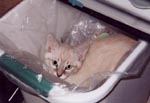 For a couple years, Allegro and I had been happy campers. He went in the
toilet, and I flushed.
As messed-up as it sounds to say this, there is no greater joy than to wake
up in the morning to a small pile of cat crap in the toilet just waiting to
be flushed. (Ok, ok, so there are greater joys, but you get the point!)
For a couple years, Allegro and I had been happy campers. He went in the
toilet, and I flushed.
As messed-up as it sounds to say this, there is no greater joy than to wake
up in the morning to a small pile of cat crap in the toilet just waiting to
be flushed. (Ok, ok, so there are greater joys, but you get the point!)