Toilet Train Your Cat
Why the heck would anyone want to toilet train a cat?
Good question, certainly worth answering first. Someone would want to toilet
train a cat because:
More sanitary? Wouldn't it be less sanitary to share a
toilet with a cat?
That's what I thought at first too. But just stop for a minute and think
about it. How sanitary is it for a cat to go in
litter digging in or around his own urine or feces? I haven't met a cat yet
that doesn't get its paws wet at least once in a while (typically more often
than not) while going in a litter box. As they try to bury their own
excrement, they get it on their paws, the litter sticks to their paws, and
they track the litter, urine and feces around the house or apartment. Then
they jump up and walk on the same kitchen countertop that you used to make
that turkey sandwich you just ate.
If the litter box is in the
bathroom like it was in mine, you will have to step out of the shower onto
the tile with your bare, moist feet and pick up every loose particle of dirty
litter in the room.
Tiny pieces of litter would often go undetected until
I put on my shoes each day, since it liked to stick to the bottom of my
damp feet. My bathroom also always looked filthy, a
definite drawback for anyone who wants to have guests over for dinner who
will invariably need to use the bathroom.
On the other hand, when a cat goes in the toilet, his paws never touch his
own excrement nor does it touch anything else that can be tracked around the
house. I find it so funny that we think at first that it's gross to
share a toilet with a cat, yet we'll gladly let a cat walk across our
bare legs just after it practically bathed in dirty cat litter. My cat
even enjoyed hanging out in his litter box playing with litter when he
got in frisky moods. Yuck!!
Wouldn't cats miss the toilet since cats "spray" their
urine, even if they do squat and aim?
Cats mark their territory by "spraying." Cats urinate by "peeing." One
technique is used on a vertical surface and the other is used on a horizontal
surface. These two techniques are not to be confused.
And just how exactly would a cat be able to squat and
aim anyway??
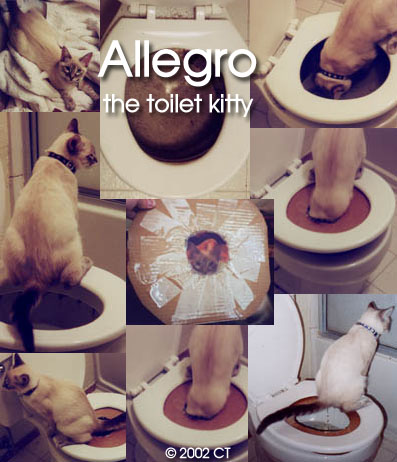
A cat cannot avoid squatting into the toilet
if it has to balance itself on the small area of one side of a toilet seat,
which is exactly what the cat will be doing by the end of its training.
How long does it take to toilet train a cat?
Using the method I suggest on this site, I would guess anywhere from 2 to 12
weeks, depending on the cat's intelligence and/or stubborness as well as the
ambitions and persistence of its owner. It took me roughly 8 weeks, but it
would have taken me less time if I had known then what I know now. I
created this site in hopes that people who train their cats after me
will do it faster and easier than I did.
Wouldn't it be more trouble to train the cat than it's
worth?
No way. There are two kinds of people in this world--there are lazy people,
and then there are ambitiously lazy people like me. Toilet
training a cat is certainly more work and more time-consuming for a few
weeks, but in the long run there is simply no contest. I am the lazy one -
those who say it's too much work are the ones who will be working the hardest
in their lifetime to take care of their cat.
Is it feasible to toilet train more than one cat at the
same time?
As strange as it sounds to say this, it may actually be easier when there is
more than one cat involved, because they can learn from each other. One would
think that the slower-progressing cats would mess up the training for the cats
who progress faster, but that theory was shattered by an
e-mail I received from someone who now has two toilet-trained cats. His
cats weren't trained at the same time, though, so I would be interested in
hearing the success stories and/or difficulties of those who train more than
one cat at the same time.
Are there any drawbacks to toilet training your
cat?
There are only a few very small drawbacks. One drawback is that, when
you have guests over to your place, they may be able to hear your cat going
if the bathroom is within hearing distance. Unless you are somehow able
to train the cat to close the door as well, your mother in law might be just
about to take her first bite of a home-cooked meal, only to be interrupted by
a faint "plop! plop!" coming from the bathroom. And as for providing a
romantic atmosphere for your lover, toilet plopping really has a way of
spoiling "the mood."
Another drawback is that tiny water drops will usually splash onto the toilet
seat when the cat goes Number Two. The drops dry up quickly, or if you're
home while the cat goes, you can easily and quickly wipe it up (especially if
you have company that may soon be using the bathroom).
One more drawback is that, once in a while, you will actually have to wait for
your cat to go before you can go yourself, assuming you only have one
bathroom. This cartoon explains it best, of course,
with a little exaggeration.
I have a question or specific situation that is not
covered anywhere on this web site. Can I e-mail you my 30-page cat
story and ask you for advice?
As much as it warms my heart that people are using my site and benefitting
from it, at this point I can't justify spending more time on the toilet
training of cats than I already have. If you need help, I recommend going
to Yahoo Groups'
Toilet group.
With the hundreds of people there eager to answer your questions, this
will be more worth your time writing the e-mail anyway!
Ok, I can't believe I'm going to say this, but I'm
actually curious and possibly even ready to start toilet training my cat.
Yes, I know you probably imagined yourself saying, "Hold on, Alphonse,
while I finish licking this red-hot charcoal" more times than you pictured
yourself saying that. Well, it's reality - toilet training is
very doable as long as you are planning to have lots of patience and
willing to be creative when faced with strange and unpredictable
obstacles that are as unique as the cat itself.
You can get started by going to Phase
I of the training instructions.
|
 "I just had to tell you how much I enjoyed your web page on toilet training
your cat. Not only was it informative but you made me laugh so hard I cried."
- Sarah Kraft, OR
"I just had to tell you how much I enjoyed your web page on toilet training
your cat. Not only was it informative but you made me laugh so hard I cried."
- Sarah Kraft, OR